
Academic & Practicum Live Course Schedule 2026
Our monthly degree student meetings focus on answering questions, teaching core academic research competencies, and helping students to build sustainable academic study skills.
Add these upcoming monthly degree student meetings (Tuesdays for 45-60 minutes) to your calendar:
🧑🏼🎓 SEPT 22 @ 1 pm EST | 18 UK | 19 D/N | 21 UAE
🧑🏼🎓 OCT 27 @ 1 pm EST | 17 UK | 18 D/N | 21 UAE
🧑🏼🎓 DEC 8 @ 1 pm EST | 18 UK | 19 D/N | 21 UAE
Watch out for meeting reminders and the Zoom link via email.
Requirement
If you book an academic course, you agree to prepare by completing the course self-study lessons, attending all live classes, and submitting assignments on time.
Academic courses have to be taken in the order displayed:
406 | D-MA-ACADWRITE - Academic Writing I (Self-Study)
407 | D-MA-STATISTICS - 10-Week Statistics & Qualitative (Self-Study)*
408 | D-MA-LITREVIEW - 6-Week Literature Review (Live)
409 | D-MA-RESEARME - 6-Week Research Methodologies (Live)
410 | D-MA-PROPO6 - 6-Week Proposal Course (Live)
* 407 can be taken anytime (must be passed before starting 410)
We suggest taking the 4 Academic Live Courses (406, 408, 409, 410) one after another, allowing you to complete your Research Proposal in approx. 6 months.
FALL 2026 - 2027 ACADEMIC COURSES
Secure your spot by submitting the attendance form on each course home page or sending an email to cody@lifestyleprescriptions.tv.
Hosted by Dr. Nick Deal
September 29, 2026
October 06, 2026
October 20, 2026
Tuesdays @ 12 noon EST / 17 UK for 45 minutes
Hosted by Dr. Nick Deal
November 24, 2026
December 01, 2026
December 15, 2026
Tuesdays @ 12 noon EST / 17 UK for 45 minutes
Hosted by Dalia Zafaar, Ph.D.
January 19, 2027
January 26, 2027
February 02, 2027
February 09, 2027
February 16, 2027
February 23, 2027
Tuesdays @ 1 pm EST / 6 pm UK / 19.00 N/D for 45 minutes
SPRING 2027 ACADEMIC COURSES
Hosted by Dr. Nick Deal
February 16, 2027
February 23, 2027
March 09, 2027
Tuesdays @ 12 noon EST / 17 UK for 45 minutes
Hosted by Dr. Nick Deal
April 06, 2027
April 13, 2027
April 27, 2027
Tuesdays @ 12 noon EST / 17 UK for 45 minutes
MA-PROPOSAL-0627
Hosted by Dalia Zafaar, Ph.D.
June 01, 2027
June 08, 2027
June 15, 2027
June 22, 2027
June 29, 2027
July 6, 2027
Tuesdays @ 1 pm EST / 6 pm UK / 19.00 N/D for 45 minutes
FALL 2026 - WINTER 2027 - STARTS NOVEMBER 05, 2026
LMWC Requirement
For LPU students enrolled in the LMWC Certification Training and M.A./Ph.D. DEGREE programs.
Curriculum & Learning Outcomes
Visit the LMWC website at www.lifestyleprescriptions.org/certification
Enroll in LMWC
Interested in getting certified? Register here | Questions? Contact us.
LMWC Faculty
Radu Bailu, MHA, MD, DipIBLM, CPHQ, CHC - Lifestyle Medicine Physician, DipIBLM, LPU Faculty, Former Romania Lifestyle Medicine Association President
Aisling Killoran, Ph.D. - Clinical Hypnotherapist & Psychotherapist, Root-Cause Health Coach, Infertility Specialist, Stress Management Faculty
Mohammad I. Yamani, M.D. - Lifestyle Medicine Primary Care Physician, Ornish Provider, LPU Chief Medical Officer
Johannes R. Fisslinger, M.A. - Founder Lifestyle Prescriptions® University, Clinical Lifestyle Medicine AI™, Author
LMWC Live Practicum Classes start Thursday, Jan 21, 2027 @ 1 pm EST | 18 UK. Additional live class dates will be announced by Nov 15, 2026
Learn about the Lifestyle Prescriptions® University Root-Cause Health Coach Certification Training (NBHWC-approved) here.
Next Live Intensive
PRAC1-RCA-0926
Wednesdays @ 1 pm EST | 18 UK (for 90 minutes)
Weekly from SEPT 23 to DEC 9, 2026
Sundays @ 1 pm EST / 18 UK (for 90 minutes)
Weekly from SEPT 27 to DEC 6, 2025
Practicum LPU Faculty
Johannes R. Fisslinger, M.A. (LPU Founder)
Aisling Killoran, Ph.D. (Root-Cause Health Coaching Infertility Specialist)
Sharon Ellert, Ph.D. (Root-Cause Health Coaching Specialist, NBC-HWC)
Jane Oelke ND, Ph.D. (Naturopathic Doctor, NBC-HWC)
CURRICULUM
You'll learn and practice the foundational skills required to become LPHC and NBHWC* certified, including:
NBHWC Coaching Skills (16 Lessons)
NBHWC 1 – Coaching Presence & Therapeutic Silence
Develop a strong coaching presence by being fully present, mindful, curious, and comfortable using intentional silence to encourage client reflection and awareness.
Technique 1: Mindful Coaching Presence
Technique 2: Purposeful Silence
NBHWC 2 – Active & Reflective Listening
Strengthen listening skills by accurately hearing, reflecting, and understanding the client's thoughts, emotions, and meaning without judgment or interruption.
Technique 1: Active Listening
Technique 2: Reflective Listening (Simple & Complex Reflections)
NBHWC 3 – Powerful Coaching Questions
Facilitate insight and self-discovery by asking open-ended, thought-provoking questions that expand awareness and encourage exploration.
Technique 1: Open-Ended Questions
Technique 2: Evocative Questioning
NBHWC 4 – Building Trust & Coaching Partnership
Establish a collaborative coaching relationship by communicating empathy, affirmation, validation, and psychological safety.
Technique 2: Empathic Reflection
NBHWC 5 – Structuring Effective Coaching Sessions
Guide coaching conversations with a clear beginning, collaborative focus, and meaningful conclusion while maintaining client partnership.
Technique 1: Agenda Mapping
Technique 2: Session Summary & Closing
NBHWC 6 – Integrating Core Coaching Communication
Integrate listening, reflections, summaries, and follow-up questions to create natural, client-centered coaching conversations.
Technique 1: Summarizing
Technique 2: Focused Reflection & Follow-Up Questioning
NBHWC 7 – Readiness for Change
Assess a client's readiness for change and help them explore motivation, ambivalence, and commitment.
Technique 1: Readiness Assessment
Technique 2: Decisional Balance
NBHWC 8 – Motivational Interviewing
Apply Motivational Interviewing strategies to evoke change talk, reduce resistance, and strengthen intrinsic motivation.
Technique 1: Eliciting Change Talk
Technique 2: Rolling with Resistance
NBHWC 9 – Values, Motivation & Self-Efficacy
Help clients connect personal values, strengths, and confidence to create lasting motivation for behavior change.
Technique 1: Values Exploration
Technique 2: Developing Discrepancy
Technique 3: Strengths Spotting
Technique 4: Evoking Self-Efficacy
NBHWC 10 – Visioning, Goal Setting & Action Planning
Guide clients in creating a compelling wellness vision, establishing meaningful goals, and developing realistic action plans.
Technique 1: Wellness/Wellbeing Visioning
Technique 2: Future Self Visualization
Technique 3: SMART Goal Setting
Technique 4: Action Planning
NBHWC 11 – Coaching Through Challenges
Help clients navigate barriers, setbacks, and uncertainty by building confidence, problem-solving skills, and resilience.
Technique 1: Scaling Questions (Confidence & Importance Scales)
Technique 2: Barrier Exploration & Client-Generated Solutions
NBHWC 12 – Accountability & Progress Review
Support sustainable behavior change by reviewing progress, celebrating success, strengthening accountability, and revising action plans.
Technique 1: Accountability & Progress Review
Technique 2: Goal Review, Learning Reflection & Plan Revision
NBHWC 13 – Ethical & Professional Coaching Practice
Apply ethical decision-making, maintain professional boundaries, recognize scope of practice, and make appropriate referrals.
Technique 1: Ethical Decision-Making Framework
Technique 2: Scope-of-Practice & Referral Decision Tree
NBHWC 14 – Health & Wellness Integration
Integrate whole-person health concepts and share evidence-informed health information using a client-centered coaching approach.
Technique 1: Whole-Person Health Exploration
Technique 2: Ask–Offer–Ask
NBHWC 15 – Coaching Practicum & Performance Improvement
Strengthen coaching competency through structured self-evaluation, peer feedback, and reflective practice.
Technique 1: Recorded-Session Self-Assessment
Technique 2: Strengths-Based Performance Feedback
NBHWC 16 – Advanced Coaching Integration & Client Case Practicum
Demonstrate competency by integrating coaching skills and techniques while coaching diverse client cases using deliberate practice.
Technique 1: Case-Based Coaching Role-Play
Technique 2: Deliberate Practice with Observer Feedback
Root-Cause Analysis with Organ-Mind-Brain Anatomy (7 Lessons)
RCA 17 – Micro-Habit Lifestyle Prescriptions®
Apply the seven Lifestyle Medicine Superpowers to create realistic micro-habits and personalized Lifestyle Prescriptions® that support sustainable behavior change.
Technique 1: Seven Lifestyle Medicine Superpowers
Technique 2: Micro-Habit Lifestyle Prescriptions®
RCA 18 – The Art and Science of Self-Healing
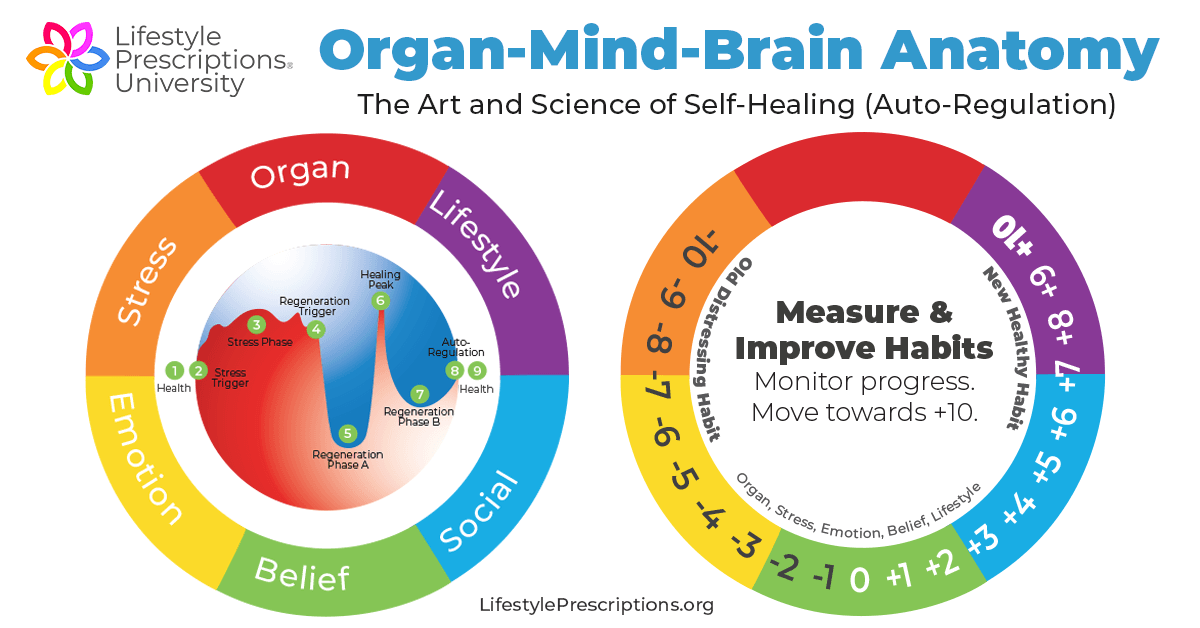
Explore the BioPsychoSocial, Organ-Mind-Brain Anatomy, Autonomous Nervous System, and the Auto-Regulation process of all symptoms
Technique 1: The 6 Root-Causes of all disease
Technique 2: The 9 Points and Phases of Auto-Regulation
Technique 3: Organ-Mind-Brain Anatomy Charts
RCA 19 – Root-Cause Coaching Process 1–5
Teach how to use the RCA 1–5 process, measure using the SUD/SUT and a personalized Lifestyle Prescription®.
Technique 1: RCA 1–5 Coaching Process Script
Technique 2: RCA Lifestyle Prescription® Using SUD/SUT
RCA 20 – Psychosocial Habit-Change Skills
Skill: Apply coaching techniques to reduce stressful emotions, reframe limiting beliefs, and use tht SUD/SUT habit transformation technique.
Technique 1: SUD/SUT Habit Transformation
Technique 2: Belief-Change Techniques
Technique 3: Energy Tapping
RCA 21 – Organ-Mind-Brain Anatomy Foundations
Beyond Mind-Body Connection by understanding Organ-Mind-Brain Anatomy from an evolutionary biology perspective.
Technique 1: Seven essential OMBA principles with examples
Technique 2: Review the 5 Organ-Mind-Brain Anatomy charts
RCA 22 – Applied Organ-Mind-Brain Anatomy
Deepen Organ-Mind-Brain Anatomy and Root-Cause Analysis with extensive chronic disease examples
Technique 1: Brain Relays, Evolutionary Survival Mechanisms, Microbiome, Combinations/Constellations
Technique 2: Root-Cause Analysis with OMBA Client-Case Analysis and Examples
RCA 23 – Student Client Cases - OMBA and RCA Review
Analyze and discuss student client cases using OMBA charts, embryology, germ layers, brain relays, organ-tissue relationships, and microbiome concepts.
Technique 1: Structured Root-Cause Case Review
Technique 2: OMBA Case Presentation and Clinical Reasoning
The Organ–Mind–Brain Anatomy (OMBA) Course teaches health practitioners to understand the BioPsychoSocial Connection by exploring how life stressors, emotions, beliefs, and evolutionary survival responses relate to organ- and tissue-specific symptoms.
Designed for health coaches and healthcare professionals, this exclusive LPU training integrates psychoneuroimmunology, evolutionary biology, and biopsychosocial principles to help practitioners create personalized, lifestyle-based interventions.
Students will learn how to decode which specific stressors, emotions, thoughts, and lifestyle habits affect specific organ tissue symptoms.
What you'll learn:
The Art and Science of Self-Healing
Understand the body's innate capacity for adaptation, repair, and recovery.The Organ–Mind–Brain Connection
Explore the relationships between emotional experiences, brain responses, and organ-specific adaptations.The 9 Points & Phases of Auto-Regulation
Learn a practical framework for recognizing and supporting the body's natural regulatory processes.The Autonomous Nervous System and Auto-regulation
Observe the sympathetic and parasympathetic patterns and symptoms, as part of the recovery processThe Essential Role of the Microbiome
Discover how microbes influence immune function, metabolism, and overall health.The SUD/SUT Habit Transformation Process
Apply a structured method for creating lasting behavioral and lifestyle change.Working with Emotions, Beliefs, and Values
Develop practical skills for helping clients identify and transform unresolved emotions, limiting beliefs, and core values that influence health and wellbeing.
You'll receive:
Pre-Study Courses an 2-Months Live Classes
Study the foundations on your own time and learn how to use OMBA and the Root-Cause Analysis Process with clients.Lifestyle Medicine AI™ OMBA Assistant
Gain exclusive access to the Lifestyle Medicine AI™ OMBA Assistant for personalized learning, instant answers to your questions, and ongoing support to deepen your understanding of Organ–Mind–Brain Anatomy.Comprehensive OMBA Knowledge Base
Access a database of more than 1,000 organ- and tissue-specific symptom patterns, including associated stress triggers, emotional responses, belief patterns, and lifestyle factors.Digital OMBA Chart Set
Receive the complete digital OMBA Chart Set as a reference for study, coaching, and clinical practice.Optional Printed OMBA Chart Set
Upgrade to a premium printed OMBA Chart Set featuring 5 full-size posters and 10 reference charts, professionally printed and available for international shipping for an additional $175.

2026 Course Dates will be announced soon.
Citations:
[Frontiers in Psychology (2016) - Psychosocial Stress and Disease]
[Journal of Clinical Medicine (2020) - Mind-Body Interactions]
To watch Lifestyle Medicine AI™ platform and Dr. HealthiWealthi™ AI masterclass recordings and to add smart educational and productivity tools in your practice and organization, visit:
Not a registered student yet?
Explore LPU Certification & Degree Program Options.

Accredited Certification, Degree Programs, and AI-Powered Productivity Tools for Lifestyle Medicine Professionals
© 2015-2026 Lifestyle Prescriptions® University. Lifestyle Prescriptions® is a registered worldwide trademark, and the terms Lifestyle Medicine AI™, Lifestyle Medicine WORKS™, Dr. HealthiWealthi™, Organ-Mind-Brain Anatomy™, Root-Cause Health Coaching™, and Lifestyle Medicine Summit are worldwide trademarks of the Lifestyle Prescriptions® University and can only be used after completing qualifying training programs.
* This website and all LPU training programs are for educational purposes only. No medical diagnosis, therapy, or treatment is provided. Lifestyle Prescriptions® may ONLY be used for educational and habit improvement purposes by LPU approved providers.
The Dangers and Benefits of Artificial Intelligence (AI) in Lifestyle Medicine and Health Coaching
Register for the upcoming masterclass on Wednesday, June 24, 2026, @ 1 pm EST | 18 UK (watch LIVE or the recording)
Watch out for the Zoom access link in your inbox.

We love your privacy and never share your data. Unsubscribe anytime.